THE HOUSE OF MAPPIN
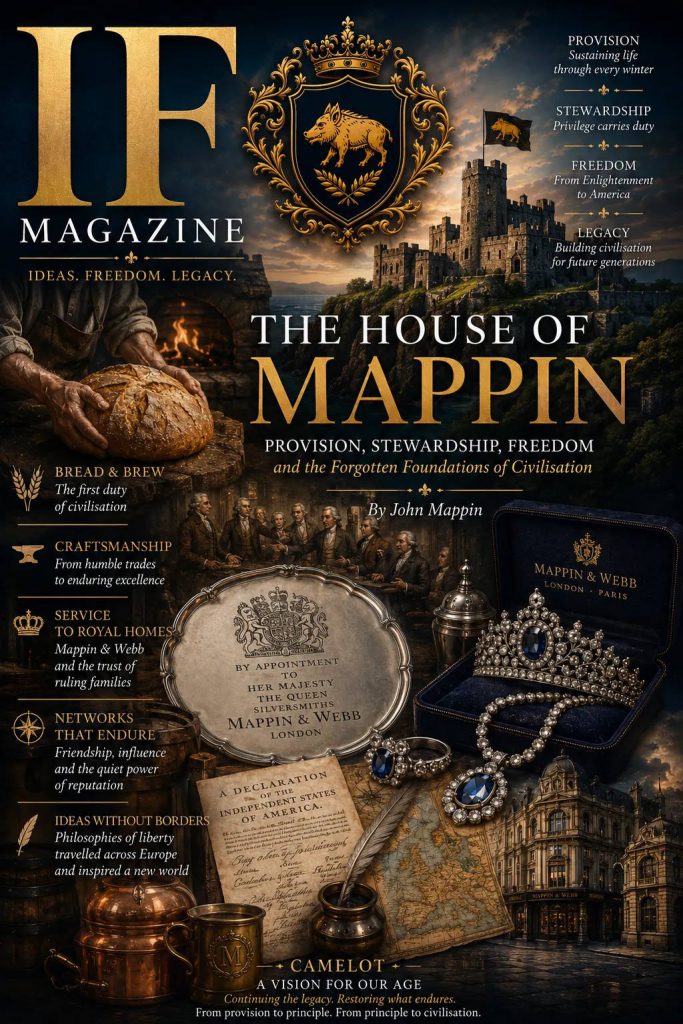
Provision, Stewardship, Freedom and the Forgotten Foundations of Civilisation
By John Mappin | IF Magazine
A Note to the Reader
Every family possesses its own history.
Some of it survives in deeds, parish registers, business ledgers and official records.
Some of it survives because generation after generation considered it too important to forget.
The House of Mappin is no different.
What follows is drawn from documented family history, traditions faithfully preserved within our family by my late father and my late aunt, together with my own reflections on their wider significance.
History is not preserved only in archives.
It is also preserved in families.
There comes a point when a tradition has been carried faithfully across enough generations that it deserves to be recorded—not as idle folklore, but as part of a family’s inheritance.
This essay is an attempt to do exactly that.
⸻
The House of Mappin
There are families remembered for conquest.
Others for titles.
Others for great military victories or political influence.
The House of Mappin remembers something rather different.
Bread.
That may sound almost disappointingly ordinary.
It is anything but.
For bread was civilisation long before civilisation acquired its cathedrals, its universities or its parliaments.
Before there could be philosophy, there first had to be harvests.
Before there could be liberty, there first had to be life.
Before men could concern themselves with rights, constitutions and governments, someone had to ensure there was still bread upon the table when winter arrived.
That simple truth lies at the heart of one of the oldest traditions preserved within my family.
For generations, the House of Mappin has understood its origins not principally through wealth or status, but through stewardship.
The story handed down to me as a child was remarkably consistent.
Our ancestors first established themselves in France.
They became associated with farming, wheat production, baking, brewing and notably with the provision of bread during the harsh winters that periodically descended upon medieval Europe.
When harvests failed and hardship spread across the countryside, they ensured that those who depended upon them continued to eat.
Whether tenant, labourer or neighbour, no distinction was made where genuine need existed.
Bread came first.
Life came first.
Everything else followed.
As a boy, I accepted this story simply because it was the history of my family.
As I grew older, I came to realise that, whether one viewed it as history, inheritance or philosophy, it contained something profoundly important.
It described a civilisation built not upon entitlement, but upon obligation.
Not upon extracting from society.
But sustaining it.
There is a tendency today to assume that wealth has always existed principally for private enjoyment.
Our ancestors would have found that idea rather strange.
Across much of medieval Europe, property carried responsibilities as naturally as it carried privileges.
Those entrusted with abundance were expected to preserve the communities around them.
The successful harvest was never entirely their own.
Neither was the full granary.
Civilisation depended upon stewardship.
The House of Mappin understood this instinctively.
Indeed, I have often thought there is a quiet symbolism in one of the earliest documented occupations of the family after its arrival in Britain.
Brewing.
Once again, grain.
Once again, cultivation.
Once again, transforming the ordinary into something capable of sustaining human life.
There is poetry in that continuity.
Bread and beer have accompanied European civilisation for thousands of years.
They nourished not merely the body, but the village itself.
Around them, communities formed.
Commerce flourished.
Friendships developed.
Peace was negotiated.
Families endured.
The more I have reflected upon our family history, the more I have come to believe that bread represented something far greater than food.
It represented trust.
A village whose ovens remained lit through winter possessed more than nourishment.
It possessed hope.
And hope, perhaps more than anything else, is the first duty of civilisation.
The principles endured.
Families change their trades.
Few change their character.
As the centuries unfolded and branches of the family established themselves in Britain, the outward expression of that stewardship evolved.
The ovens gave way to workshops.
Grain gave way to silver.
Bread gave way to craftsmanship.
Yet the underlying purpose remained recognisable.
To serve.
To create.
To be relied upon.
One of the remarkable lessons of history is that civilisation advances not merely through ideas, but through trust.
Trust is accumulated slowly, over generations, through keeping one’s word, producing work of enduring quality and understanding that reputation is a form of inherited capital.
The House of Mappin came to understand that lesson well.
In time, the family became associated with one of Britain’s great commercial names: Mappin & Webb.
To the casual observer, the journey from bread to jewellery appears extraordinary.
I have never thought so.
Both occupations required precisely the same virtues.
Patience.
Precision.
Integrity.
The baker understands that a poor loaf is immediately apparent.
The jeweller understands that poor workmanship is eventually discovered.
Both trades depend upon trust.
Neither survives for long without it.
The material changed.
The philosophy did not.
The family found itself entrusted not simply with precious metals and gemstones, but with objects that marked the most important moments in the lives of nations and families alike.
Royal households.
Statesmen.
Military leaders.
Diplomats.
Great families of Britain and, increasingly, of Europe.
To serve such people was not merely to conduct commerce.
It was to become part of a network built upon confidence and discretion.
The finest craftsmen have always occupied a curious place in civilisation.
They stand close enough to power to observe it, yet their true loyalty is not to transient governments, but to excellence itself.
Kings come and go.
Ministers rise and fall.
Dynasties flourish and decline.
But craftsmanship, honour and reputation outlive them all.
It is perhaps no surprise that families devoted to enduring standards often found themselves welcomed across Europe.
Commerce has always carried more than goods.
It carries conversation.
It carries manners.
It carries ideas.
Long before newspapers reached every household, and long before electronic communication collapsed distance, merchants, craftsmen and travellers quietly transported philosophies from one capital to another.
Ideas crossed borders disguised as ordinary commerce.
—
Within our family another tradition has been preserved with equal consistency.
It was always said that later generations of the House of Mappin quietly supported circles of thinkers, printers and patrons associated with the great intellectual awakening that became known as the Age of Enlightenment.
Whether through commerce, patronage or personal friendship, the family believed that the defence of reason, liberty of conscience and the free exchange of ideas was every bit as important as the provision of bread itself.
Those same ideas would, in time, find powerful expression across the Atlantic in the founding principles of the United States.
That is one of the least appreciated truths of European and Modern American history.
The civilisation we inherited was not created solely by monarchs or parliaments.
It was woven together by thousands of relationships built upon mutual respect, professional excellence and personal confidence.
In that sense, the workshops of Europe became every bit as important as its palaces.
The House of Mappin understood that influence is most durable when it is exercised quietly.
The family tradition has always been that relationships were valued not for advantage alone, but because enduring friendships between responsible men and women strengthened the civilisation they served.
Power seeks attention.
Influence rarely does.
That distinction has become increasingly important to me.
As I have reflected upon the traditions of my own family, I have come to believe that the greatest contribution any family can make is not merely commercial success, but the patient transmission of principles from one generation to the next.
Stewardship.
Responsibility.
Religious freedom.
Respect for conscience.
The dignity of honest work.
The understanding that prosperity carries obligations as well as privileges.
These are not fashionable ideas.
They are, however, remarkably durable.
Perhaps that is why they have survived.
History moves in long cycles.
The institutions change.
The names upon the doors change.
The technologies change.
Human nature changes very little.
Every civilisation must eventually answer the same questions.
What is wealth for?
What is power for?
What is freedom for?
What do we owe one another?
Those questions are no less urgent today than they were in medieval France or Enlightenment Britain.
In many respects, they are more urgent.
It is here that my own story intersects with the older story of my family.
Camelot Castle was never intended to become merely a successful hotel.
Nor was it acquired simply because of its extraordinary position overlooking the Atlantic.
Camelot is an idea before it is a building.
For centuries, the legend of Camelot has represented something greater than Arthur himself.
It represents the aspiration that civilisation can be ordered around honour rather than fear, service rather than selfishness, courage rather than convenience, and truth rather than fashion.
Whether King Arthur was history, legend or a fusion of both is, in one sense, beside the point.
The ideals have outlived the debate.
That, surely, is the true measure of civilisation.
When I look back across the traditions of the House of Mappin—from bread to brewing, from craftsmanship to commerce, from service to sovereigns to the enduring relationships that connected families across Europe—I do not see a sequence of unrelated occupations.
I see a single thread.
The thread is stewardship.
The form changes.
The principle endures.
If Camelot has any purpose in our own age, it is to continue that thread.
Not by attempting to recreate the past, but by recovering those principles that enabled free societies to flourish in the first place.
To encourage reason over hysteria.
Dialogue over division.
Responsibility over entitlement.
Liberty anchored by conscience.
Prosperity guided by service.
These are not merely political ideas.
They are civilisational ones.
And civilisation, in the end, is sustained in exactly the same way it has always been sustained.
One family.
One friendship.
One act of trust.
One generation at a time.
That, at least, is the inheritance we received.
It is also the inheritance we hope to leave behind.
