We thought you might enjoy the enclosed , please do send this along to any family or friends who you think might enjoy . Wishing you a pleasant day from all the family, .
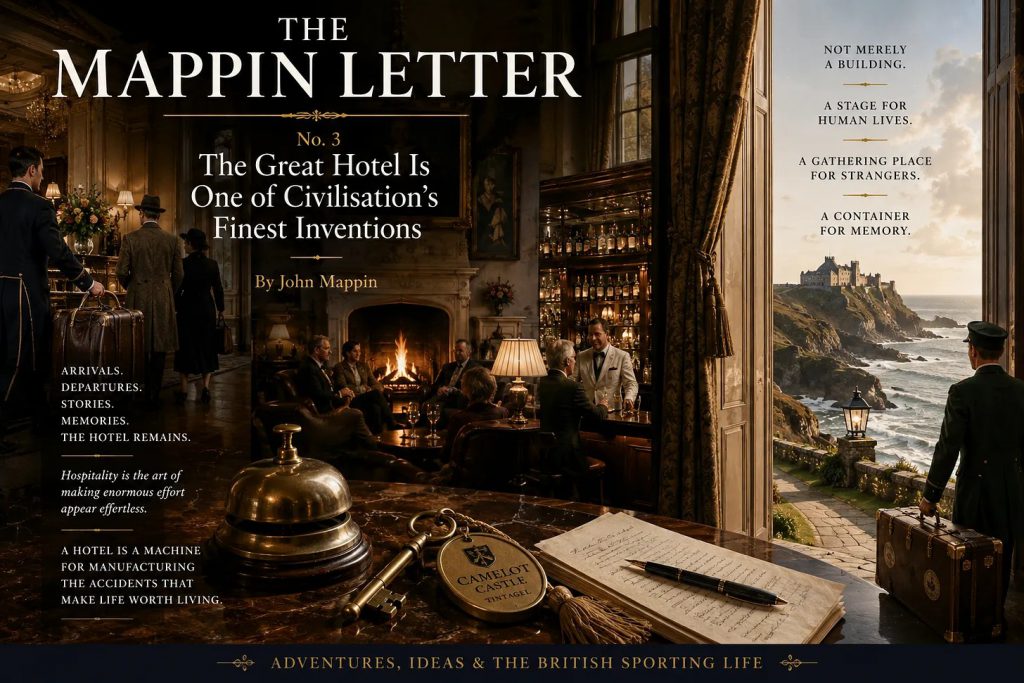
No. 3 — The Great Hotel Is One of Civilisation’s Finest Inventions
By John Mappin
There are few inventions more civilised than a great hotel.
I don’t mean merely an expensive hotel.
Expensive hotels are quite common.
Great hotels are extraordinarily rare.
A great hotel is not really a building at all. It is a stage upon which thousands of lives briefly intersect.
People arrive.
People leave.
Some fall in love. Some make fortunes. Some lose them. Deals are conceived over breakfast. Friendships begin at the bar. Marriages are proposed. Arguments erupt. Families return year after year until eventually their children arrive with children of their own.
And all the while the hotel remains.
I have spent a considerable part of my life thinking about hotels, not least because I have had the privilege—and occasionally the ordeal—of owning one.
Hotel ownership teaches you something very quickly.
The public has absolutely no interest in your problems.
Nor should it.
The boiler may have exploded.
A chef may have disappeared.
The roof may be engaged in an argument with the Atlantic.
Three members of staff may have telephoned simultaneously to announce mysterious illnesses.
None of this matters to the gentleman arriving at four o’clock.
He would like his room.
And he would like it to be warm.
This is an excellent lesson in reality.
Hospitality is the art of making enormous effort appear effortless.
The guest should never see the machinery.
He should simply feel that everything is somehow as it ought to be.
The fire is burning.
The room is ready.
Someone remembers his name.
The drink appears.
For a few hours the world becomes slightly more agreeable.
That sounds simple.
It isn’t.
Perhaps this is why the truly great hotels develop personalities.
You can feel them.
Walk into Claridge’s, the Ritz in Paris, the Gritti Palace in Venice or one of the great old Swiss hotels and you immediately understand that you have entered somewhere rather than merely checked into something.
There is memory in the walls.
Modern hotel designers occasionally forget this.
They spend extraordinary sums creating buildings of impeccable taste in which absolutely nothing has ever happened.
Everything is beige.
The chairs are beige.
The carpets are beige.
The walls are beige.
After twenty-four hours the guest begins to suspect that he too may have become beige.
Give me eccentricity.
Give me the slightly ridiculous staircase.
Give me the enormous fireplace.
Give me the portrait whose subject nobody can quite identify.
Give me the barman who has been there for thirty years and knows considerably more about international affairs than most ambassadors.
Perfection is overrated.
Character is priceless.
This is true of people too.
The individuals we remember most fondly are rarely the most perfectly polished.
They are the ones with stories.
Hotels collect such people.
That is what makes them fascinating.
At Camelot Castle, overlooking the Atlantic at Tintagel, I have watched this process for years.
People arrive from every corner of the world.
Some know precisely why they have come.
Others have simply followed the road until they reach the sea.
They walk through the door carrying their histories with them.
For a short time, all these separate stories occupy the same building.
This is one of the things I love about hospitality.
A hotel is one of the few remaining places where strangers are still permitted to speak to one another.
The modern world has become strangely suspicious of spontaneous human contact.
We travel with headphones.
We eat while looking at telephones.
We conduct business through screens.
Algorithms increasingly decide whom we encounter and what opinions we hear.
But sit beside somebody at a hotel bar and none of that applies.
You don’t know his algorithm.
He doesn’t know yours.
So you talk.
And every so often the person on the next stool turns out to be extraordinary.
This has happened to me often enough that I no longer regard it as accidental.
Put interesting people in an interesting building and interesting things happen.
It is practically a law of nature.
The great hotels understood this instinctively.
They weren’t simply selling bedrooms.
They were providing meeting places.
London clubs understood it.
The old European cafés understood it.
Country houses understood it.
Civilisation requires places in which human beings can encounter one another without knowing precisely what the outcome is supposed to be.
This is increasingly important because efficiency, for all its virtues, is slowly removing chance from our lives.
We book the car through an app.
We order the food through an app.
We meet people through an app.
We are entertained by an algorithm which has calculated what we enjoyed yesterday.
Everything becomes frictionless.
But some of the greatest events in life begin with friction.
A missed train.
The wrong table.
An unexpected invitation.
A stranger saying hello.
A hotel is a machine for manufacturing these accidents.
That is why I think they matter.
And there is another reason.
Hospitality is an ancient human virtue.
Before there were hotel corporations and loyalty programmes there was the simple idea that the traveller arriving at your door should be welcomed, fed, warmed and protected.
Civilisation begins with such gestures.
Here is a bed.
Here is some food.
Sit beside the fire.
Tell us where you have come from.
These words are thousands of years old in spirit.
Perhaps that is why the best hotels produce such powerful loyalty.
We don’t merely remember the mattress.
We remember how the place made us feel.
We remember the Christmas there.
The summer there.
The person we met there.
The dinner which went on far too late.
The morning we opened the curtains and saw the mountains, or Paris, or Venice, or the Atlantic.
Eventually a building becomes a container for memory.
And that is when a hotel becomes something greater than a business.
It becomes an institution.
The accountants may find this difficult to place on a balance sheet.
But it is probably the most valuable asset the hotel possesses.
Of course, one must still fix the boiler.
Civilisation has its limits.
John Mappin
The Mappin Letter
Adventures, Ideas & the British Sporting Life
