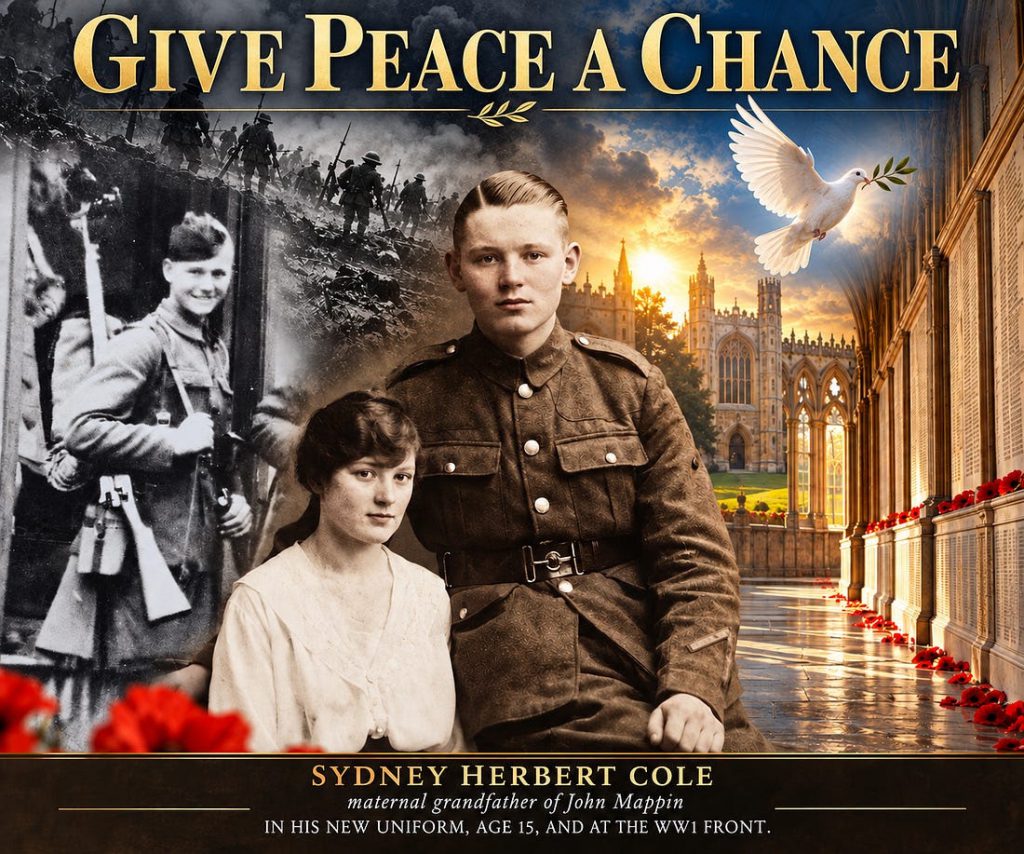
By John Mappin
I was trying recently to remember when I first became aware of the tragedy of modern war.
Perhaps it was the fact that I never met my maternal grandfather.
In 1915, at fifteen years old, he signed up to go to the Front. He went, as so many boys did, because his friends were going. One imagines the excitement, the uniforms, the extraordinary innocence of it all. A boy setting off on what he had been told was a great adventure.
He returned with chlorine-gas poisoning and shrapnel in his lungs.
He never really recovered.
His injuries condemned him to years of suffering and eventually to an early and painful death. There were stories in the family of a failed attempt to take his own life, simply to escape from a body that had been so terribly damaged.
I never knew him. But in a curious way, the war introduced him to me.
And perhaps those stories gave me my first understanding that the casualties of war are not statistics. They are missing grandfathers. Missing fathers. Missing sons. They are empty chairs at family tables and people whom later generations know only from photographs and stories.
Or perhaps my understanding came later, at Winchester.
As a boy at Winchester College, each day I walked up to school through the beautiful War Cloister.
It is one of the most elegant and moving memorials in England. Yet what it commemorates is almost unbearable.
The names are there.
Boys who had walked the same paths. Sat in the same classrooms. Laughed with their friends. Worried about examinations. Dreamed of the lives ahead of them.
Then came the First World War.
An extraordinary number of Winchester men were killed. A generation walked out through the gates of their schools and universities and, in far too many cases, never came home.
There is something particularly haunting about reading the names of the dead when you yourself are still a schoolboy.
You realise that they were not fundamentally different from you.
They were young.
They trusted their elders.
They believed what they were told.
And then they were sent to kill other young men who, in most cases, had no personal quarrel with them whatsoever.
That is the obscenity at the heart of war.
The young man in one trench has usually never met the young man in the other. He has never been cheated by him, insulted by him or harmed by him. They may have more in common with one another than either has with the politicians and strategists directing the battle from far away.
Yet somehow each has been persuaded that the other must die.
Modern technology has only made this more terrible.
The machine gun industrialised killing. Gas industrialised suffering. Bombers brought war into people’s homes. Nuclear weapons gave mankind the ability to destroy cities in seconds.
Today drones can kill people from miles away. Missiles cross borders in minutes. And nuclear arsenals remain capable of ending millions of lives before most of us would even understand what had happened.
Yet beneath all the technology, war remains strangely primitive.
A mother loses her son.
A child loses his father.
A wife loses her husband.
A family waits for someone who will never walk through the door again.
And fifty years later a grandson wonders about the grandfather he never met.
This does not mean that nations have no right to defend themselves. Nor does it mean that evil never has to be confronted. History provides terrible examples of what happens when aggression is simply permitted to advance unchecked.
But precisely because war may sometimes become unavoidable, it should never become casual.
War should be the absolute failure point of statesmanship — the thing responsible leaders exhaust every reasonable possibility to prevent.
Diplomacy is not weakness.
Talking to one’s enemies is not betrayal.
Indeed, there is little point talking only to one’s friends. The people with whom peace must ultimately be made are almost by definition the people with whom relations have become difficult, hostile or even hateful.
The statesman who prevents a war may never receive a monument.
There are no dramatic photographs of the battle that did not happen. No medals are awarded for the missile that was never launched. No memorial is constructed for the thousand young men who lived to become fathers and grandfathers because two governments found a way to compromise.
Yet perhaps these are among the greatest victories available to mankind.
We have become very good at remembering the dead.
We build monuments to them. We lay wreaths. We sound the Last Post. We say, quite properly, that we will remember them.
But perhaps the greatest way to honour them is not merely to remember how they died.
It is to remember why peace matters.
Whenever I think about war, somewhere in my mind is still that fifteen-year-old boy in 1915.
My grandfather.
Setting off with his friends.
He could not possibly have understood what chlorine gas would do to his lungs. He could not have imagined the shrapnel that would remain in his body. He could not have known the suffering that awaited him, or that a grandson he would never meet would one day write about him.
Millions of families possess some version of that story.
British families. French families. German families. Russian families. Ukrainian families. American families. Israeli families. Palestinian families. Iranian families.
Different uniforms.
Different languages.
The same grief.
There will always be voices explaining why the next war is necessary, why negotiation is impossible and why peace must wait until one more objective has been achieved.
Sometimes those arguments may prove justified.
But the burden of proof should always rest upon those proposing war, never upon those asking whether there remains a path to peace.
Because the people who pay the ultimate price are very rarely the people making the speeches.
They are somebody’s son.
Somebody’s daughter.
Somebody’s father.
Somebody’s grandfather.
And sometimes they are only fifteen years old.
Give peace a chance.